Monday, June 18, 2012

W is for Westmoreland

In 1889, two brothers, George and Charles West, left the Specialty Glass Company in E. Liverpool, OH to open the Westmoreland Glass Company in Grapeville, PA.  The natural gas-rich area provided a plentiful energy source for the production of high quality pressed glass tableware and specialty jars designed for vinegar, mustard, extracts and candy.  Their signature item was milk glass Hens on Nests produced during the 1920's through the 1950's, as well as novelty 'packer's goods'.  The West brothers manufactured two lines for Woolworth's as well as some of America's finest cut glass.  One of the most well known patterns,  Paneled Grape, was first produced in the late 1800's as a thinner more translucent white glass.  Westmoreland became well known for its glass toys such as submarines, wagons, windmills, automobiles, trains, animals, revolvers - countless lines of novelty gift ware.  To set themselves apart, much of the glassware was hand decorated.  At the turn of the 20th C this was an appreciated distinguishing element separating Westmoreland from the myriad of glass companies in existence at that time.

In response to the faltering economy of the Great Depression (1929-1940), the company reorganized in 1937 selling its holdings to Ira Brainard who purchased it for his sons. Westmoreland Glass continued to make lovely, heavy opaque milk glass until closing its doors just shy of its 100 year Anniversary in 1984.  Many of its molds were sold to companies still in operation at that time including Blanko, Summit and Viking Glass.  Take home a piece of history with Westmoreland milk glass and see for yourself just how happy you can be with the simple things in life!   Enjoy the hunt!

 Hens on Nests, Westmoreland Glass Company

 Hen Party

 Novelty Glass Wheelbarrows, Westmoreland Glass Company


signature

Monday, June 11, 2012

Wabi-Sabi

What is wabi-sabi you ask?  It is beauty found in the imperfect and the impermanent; of things modest and humble.  It is a nature-based aesthetic that is applied to the art of living a creatively conscious life. Wabi-sabi is about the fine balance that exists between the pleasure we receive from acquiring 'things' and the ultimate contentedness we feel when not encumbered by 'things'.  Wabi-sabi is about hidden aspects and overlooked specialness;  the understated and the unassuming.  It is the elegant simplicity of a quiet tea ceremony:  boiling and pouring the water, preparing the tea, serving with grace, enjoyment.

One must sloooow downnnn , be patient, and look very closely to experience and appreciate subtleties that are the essence of wabi-sabi..... Practicing it in small ways can change your life.


Monday, June 4, 2012

V is for Vaseline Glass

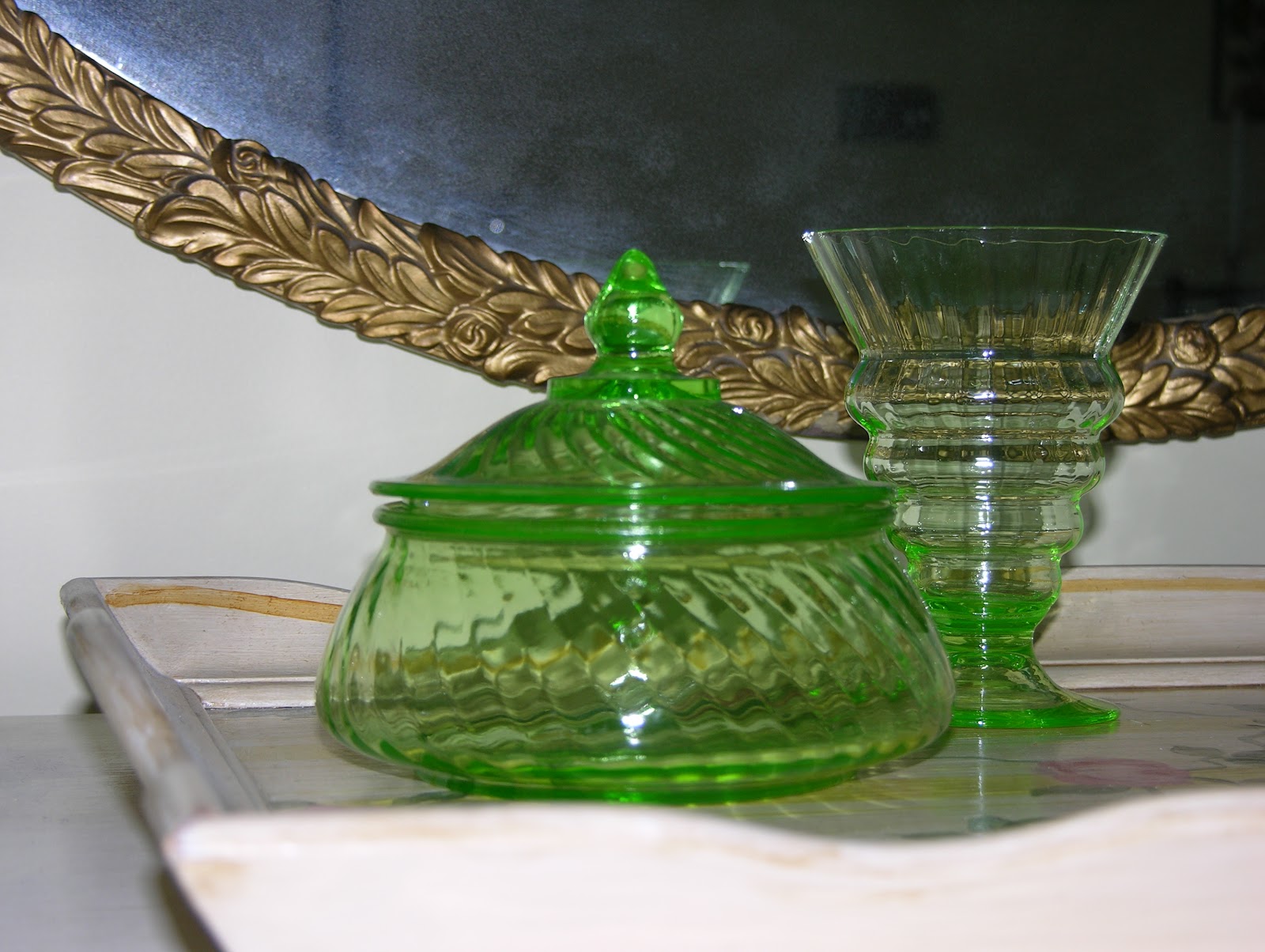
The name vaseline conjures up an image of that ubiquitous household item -  a jellied lemony colored balm,  soothing as an elixir of sorts for dry skin and lips.  It was during the early 19th C that a glass was produced that replicated the color of this luscious product through the addition of uranium dioxide.  The resulting formula produced a very cool yellow green coloration,  florescent under an ultra-violet black light that 'excites' the outer electrons of the uranium atoms causing them to glow! Names for this unique hue include citron, jasmine, golden green, mustard, canary and Florentine with colorations ranging from yellow to green depending on the oxidation state and concentration of the metal ions present in the mix.  The higher the uranium dioxide content, the greater the florescence and bright green energy we see.  A Geiger Counter will register very low levels of radioactivity from authentic Vaseline Glass which is insignificant and close to the amounts of the natural radioactivity surrounding us.

As a form of Art Glass, Vaseline Glass is considered highly collectible.  Its neon punch of color is very hip and certainly creates that dash of intensity and vibrancy that makes a room come alive.
 Happy Hunting!


signature

Monday, May 28, 2012

Very Proud

 'Vow to be valiant.  Resolve to be radiant.  Determine to be dynamic.  Strive to be sincere.  Aspire to be attuned.'  
William Arthur, 1921-1994, American Inspirational Writer


Memorial Day, 2012 


signature

Monday, May 21, 2012

U is for U.S.A. Pottery

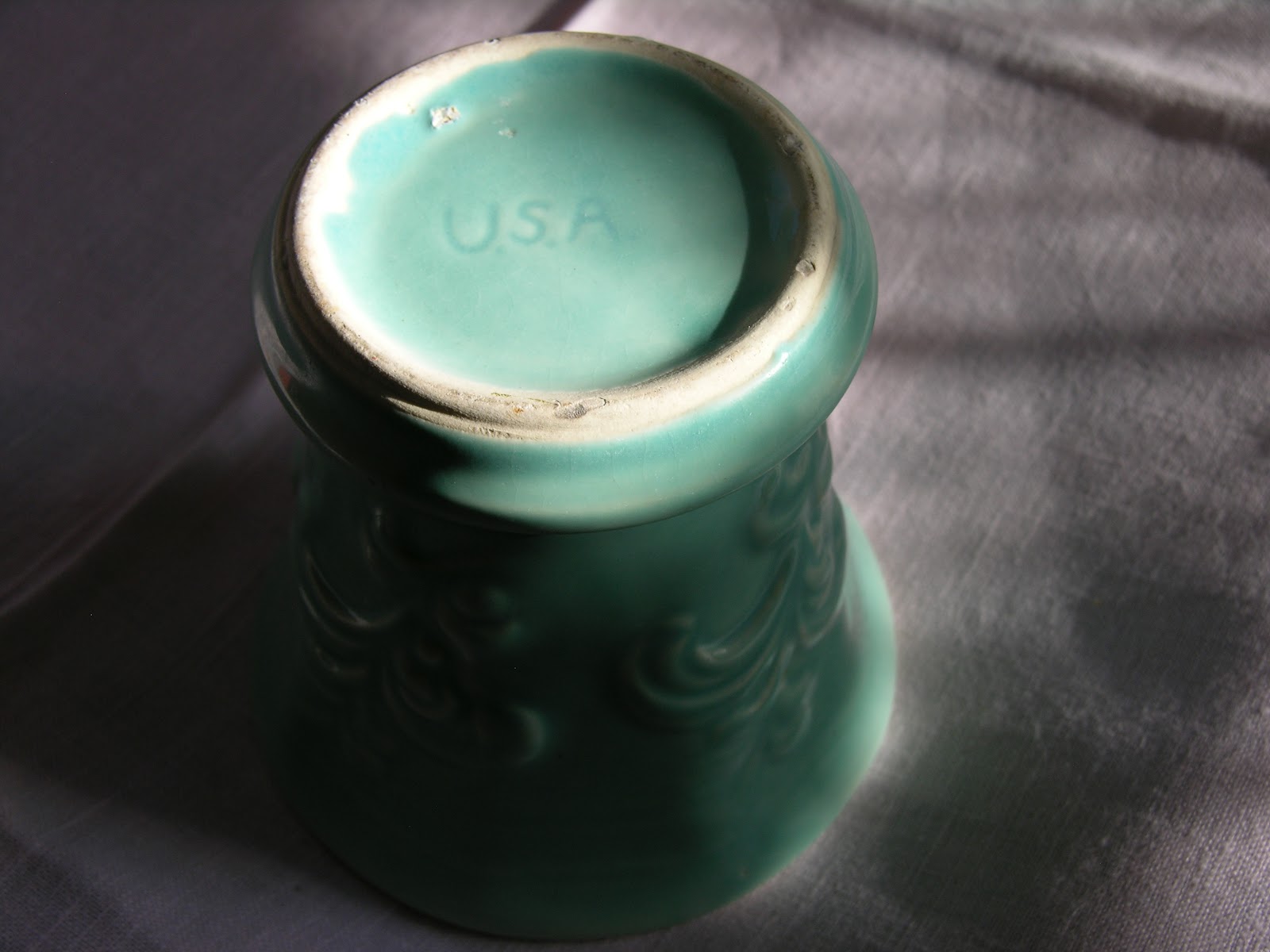
 Vintage pottery marked USA is not pottery made by a specific company.  It was, in fact, a patriotic gesture resulting initially from the Great War (WWI, 1914-1918) and later from WWII (1939-1945) whereby companies proudly identified with their country of origin.  The  McKinley Tariff Act of 1891 required country of origin identification on all products imported into the US.  However, marks could include paper labels which oftentimes fell off making it difficult to identify the country.  Most USA marked pottery was manufactured by Shawnee Pottery and McCoy Pottery. The best way to learn more about this vintage mark is to familiarize yourself with these potteries and their wares.  Happy Hunting!


signature

Monday, May 14, 2012

Under the Weather

 Unable to post.  Miss you until next time.


signature

Monday, May 7, 2012

T is for Tiffin


Tiffin Classic Pattern

In 1845, Joseph L. Beatty and Edward Stillman started a glass factory in Steubenville, OH calling it simply the Beatty Glass Works.  It became known for its production of fine tableware and tumblers, supporting 150 glass artisans.  During the Civil War, A.J. Beatty & Sons Glass Company led all others in the US, with production of tumblers, beer and wine glasses and decorative bottles.  Glass makers pressed and created blown finely tinted opalescent glass which was also skillfully engraved.  Tiffin Glass is the product of a merger in 1893, between US Glass and A.J. Beatty & Sons.  Beatty & Sons relocated to Tiffin, OH in 1888, establishing a glass factory that created as many as 500,000 pieces of pressed glass tumblers per week!  Designated as Factory R, it became one of 19 factories owned by US Glass nationwide.

During the early 1900's, customer demand created a shift from pressed to blown tableware.  Until 1927 Tiffin glass products were identified with the paper label 'USG' from the US Glass Company, with the gold paper 'TiffinT' shield label appearing from 1927-1940.  Tiffin manufactured  what is known as Elegant Glass, with the earliest patterns including:  Cadence, Cherokee Rose, Classic, Flanders, Fuchsia, and King's Charm.  The 1940's brought major changes to the industry, with fewer types of glasses produced in stemware lines, a resurgence in appreciation for crystal pieces and an interest in fine china table settings.  In response to this, Tiffin glassware became known as 'America's Prestige Crystal' and the revered Lady Stems glassware were popularized from 1939-1956.  

Financial problems plagued all of the Elegant Glass companies in the 1950's, with the advent of inexpensive imports from overseas. Tiffin was the only US Glass Company plant remaining in the United States in 1951; despite this reprieve, the company filed for bankruptcy protection in 1962.  A year later, a group of employees bought the factory, renaming it Tiffin Art Glass Company, purchasing the glass molds from the T.G. Hawkes Cut Glass Company of Corning, NY.  Three years later in 1966 the company was sold once again and renamed Tiffin Glass Company, continuing production of beautiful blown and pressed stemware.

Tiffin Glass Company finally closed its doors in 1980 upon being sold to Towle Silversmiths. 
As you hunt for treasures, keep this special piece of US glass history in mind; you will not be disappointed with a Tiffin glass find, guaranteed.  Have fun!


signature
Related Posts with Thumbnails