Monday, May 28, 2012

Very Proud

 'Vow to be valiant.  Resolve to be radiant.  Determine to be dynamic.  Strive to be sincere.  Aspire to be attuned.'  
William Arthur, 1921-1994, American Inspirational Writer


Memorial Day, 2012 


signature

Monday, May 21, 2012

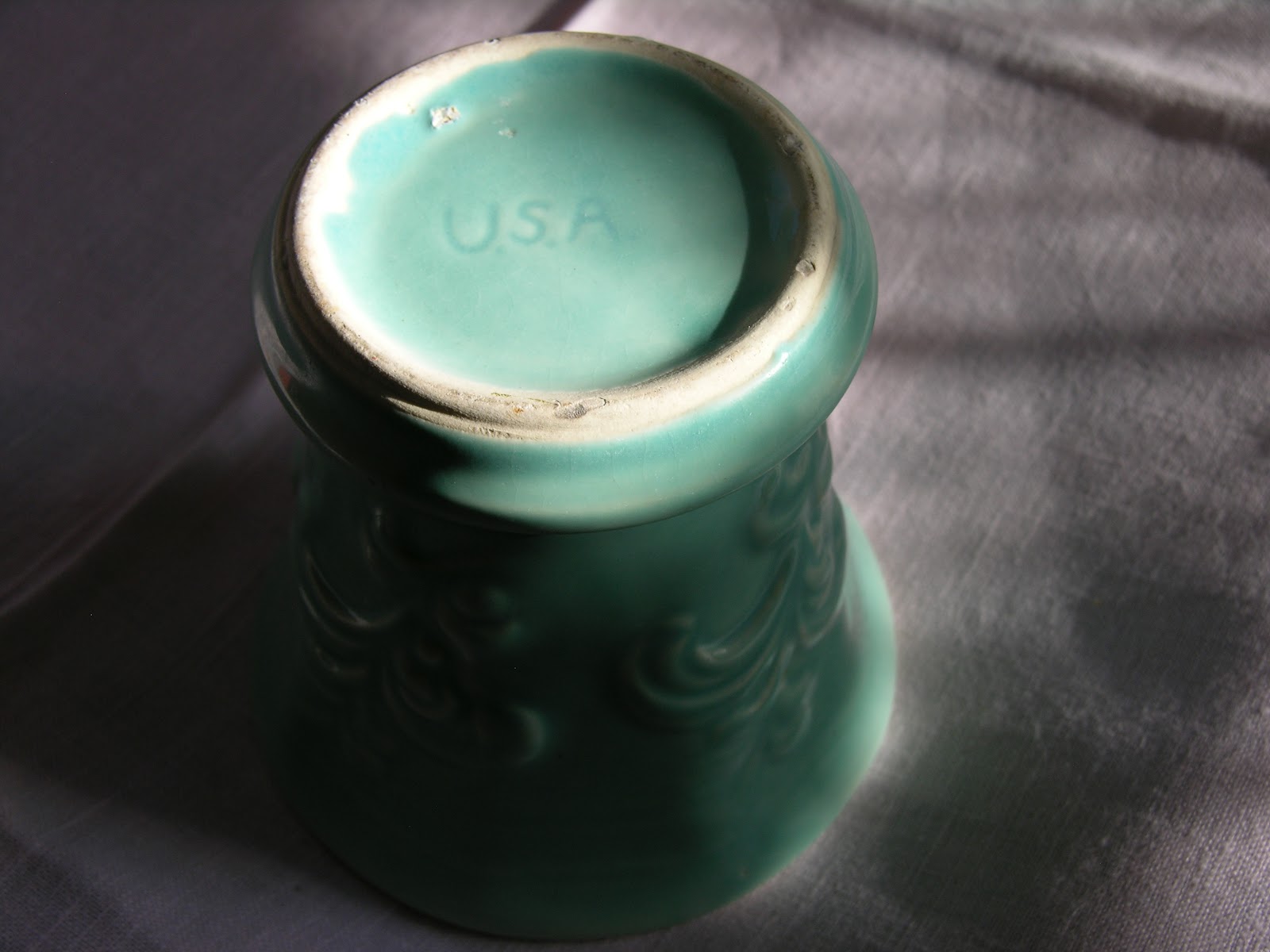
U is for U.S.A. Pottery

 Vintage pottery marked USA is not pottery made by a specific company.  It was, in fact, a patriotic gesture resulting initially from the Great War (WWI, 1914-1918) and later from WWII (1939-1945) whereby companies proudly identified with their country of origin.  The  McKinley Tariff Act of 1891 required country of origin identification on all products imported into the US.  However, marks could include paper labels which oftentimes fell off making it difficult to identify the country.  Most USA marked pottery was manufactured by Shawnee Pottery and McCoy Pottery. The best way to learn more about this vintage mark is to familiarize yourself with these potteries and their wares.  Happy Hunting!


signature

Monday, May 14, 2012

Under the Weather

 Unable to post.  Miss you until next time.


signature

Monday, May 7, 2012

T is for Tiffin


Tiffin Classic Pattern

In 1845, Joseph L. Beatty and Edward Stillman started a glass factory in Steubenville, OH calling it simply the Beatty Glass Works.  It became known for its production of fine tableware and tumblers, supporting 150 glass artisans.  During the Civil War, A.J. Beatty & Sons Glass Company led all others in the US, with production of tumblers, beer and wine glasses and decorative bottles.  Glass makers pressed and created blown finely tinted opalescent glass which was also skillfully engraved.  Tiffin Glass is the product of a merger in 1893, between US Glass and A.J. Beatty & Sons.  Beatty & Sons relocated to Tiffin, OH in 1888, establishing a glass factory that created as many as 500,000 pieces of pressed glass tumblers per week!  Designated as Factory R, it became one of 19 factories owned by US Glass nationwide.

During the early 1900's, customer demand created a shift from pressed to blown tableware.  Until 1927 Tiffin glass products were identified with the paper label 'USG' from the US Glass Company, with the gold paper 'TiffinT' shield label appearing from 1927-1940.  Tiffin manufactured  what is known as Elegant Glass, with the earliest patterns including:  Cadence, Cherokee Rose, Classic, Flanders, Fuchsia, and King's Charm.  The 1940's brought major changes to the industry, with fewer types of glasses produced in stemware lines, a resurgence in appreciation for crystal pieces and an interest in fine china table settings.  In response to this, Tiffin glassware became known as 'America's Prestige Crystal' and the revered Lady Stems glassware were popularized from 1939-1956.  

Financial problems plagued all of the Elegant Glass companies in the 1950's, with the advent of inexpensive imports from overseas. Tiffin was the only US Glass Company plant remaining in the United States in 1951; despite this reprieve, the company filed for bankruptcy protection in 1962.  A year later, a group of employees bought the factory, renaming it Tiffin Art Glass Company, purchasing the glass molds from the T.G. Hawkes Cut Glass Company of Corning, NY.  Three years later in 1966 the company was sold once again and renamed Tiffin Glass Company, continuing production of beautiful blown and pressed stemware.

Tiffin Glass Company finally closed its doors in 1980 upon being sold to Towle Silversmiths. 
As you hunt for treasures, keep this special piece of US glass history in mind; you will not be disappointed with a Tiffin glass find, guaranteed.  Have fun!


signature

Monday, April 30, 2012

Ode to our Nation


It was the 30th of April, 1789 on the balcony of Federal Hall in New York City, when George Washington was inaugurated into office as the First President of the United States.  It is interesting to compare this important date in our nation's history to the current state of our political affairs.  As 44th
President, Barack Obama is the first black man in 233 years to hold this lofty position, elected under the tenet of an 'unwavering believe in the ability to unite people around a politics of purpose.'  To contrast this with the election of 1789 it is important to note there was no popular vote at that time.  As such, the Electoral College chose the candidates with each college member casting two votes, for a total of 69.  Washington was elected unanimously, followed by John Adams who served as the first Vice President.  It was Commander-in-Chief Washington's ability to lead the Continental Army to victory over England during the Revolutionary War from 1775-1783 that earned him the highest acclaim and respect within the new nation.   His influence in the writing of the Constitution (1787) contributed to the popular title  'Father of his Country' as he won acceptance for his leadership style and his vision.  He ranks third amongst the most influential US Presidents, behind Abraham Lincoln and Franklin Delano Roosevelt.

Washington was not a member of any political party and hoped that political parties would NOT be formed, fearing conflict would undermine Republicanism.  He believed the United States of America should be built along 'Republican' lines using federal power to effect change.  He sought a national government to 'preserve liberty, improve infrastructure, open the Western lands, promote commerce, found a permanent Capital, reduce regional tensions and promote a spirit of American nationalism.' Slavery was opposed on moral and economic grounds and as such he was the only Founding Father to free all his slaves upon his death in 1799.  His eulogy honored him as the "first in war, first in peace and first in the hearts of his countrymen." 

George Washington -  symbol for liberation and nationalism;  have we honored his vision?


signature

Monday, April 23, 2012

Trees

'I like trees because they seem more resigned to the way they have to live than other things.' - Willa Cather, 1873-1947, American Author


Malus 'Mary Potter' in glorious bloom!

April blossoms welcoming me home .... Life can be truly beautiful. Happy Spring!
signature

Monday, April 16, 2012

S is for Stangl

Stangl Pottery of Trenton, NJ was initially produced simultaneously with Fulper Pottery of Flemington, NJ and incorporated in 1955 as the Stangl Pottery Company. The origins are somewhat unclear except to note that a utilitarian pottery factory in the same location was begun by Samuel Hill in 1805, producing drain pipes, storage crocks and jars all from the lovely red earthenware clay inherent in that region of Jew Jersey. Abram Fulper acquired that company in the 1860's and by 1900 the Fulper Pottery Company became renowned for its Vasekraft art pottery line. In 1910, Fulper hired ceramic engineer Johan Martin Stangl from Hoff, Germany to develop new pottery shapes and glazes, which catapulted sales due to its popularity. Stangl was responsible for the company's signature line of open stock solid-color dish ware, known as Fulper Fayence, with colors such as Chinese Ivory, Colonial Blue, Silver Green and Persian Yellow. He became CEO in 1928 upon the death of William Fulper and saw the company through devastating fires and relocation in Flemington. The names Fulper and Stangl were both used as marks on the pottery, with the Stangl name becoming most common by the 1940's, at which time hand painted florals became the rage. Johan Martin Stangl died in 1972, with his estate running the factory until it was purchased by Pfaltzgraff in 1978. As Stangl Pottery is widely available and affordably priced, the hunt for it will not disappoint. Have fun!
Proudly, Made in the USA.


Bittersweet Pattern, handpainted


signature

Related Posts with Thumbnails