Monday, October 17, 2011

J is for Being Jeweled


Jewelry.... throughout history it has existed as an integral part of human expression and wealth. Beginning with the first rudimentary necklace of shells strung together with twine and continuing into the reigns of Egyptian, Greek and Roman Kings. When gold, silver, and cameos were introduced to the world many millenniums ago, jewelry existed as a form of currency, a symbol of the gods, and the ultimate in physical adornment.

During the Middle Ages (5th-14th C), Christian monasteries designed religious jewelry as a means of supporting themselves. The Renaissance (15th-17th C) became known as the Jewel Age, with secular creations of jewelry as works of art for the sole purpose of enhancing beauty. Gemstones were prized for their lustrous colors; diamonds for their rarity. Improved methods for cutting diamonds increased their availability during the 17th C and beyond. Each period in history - Georgian (1714-1830), Victorian (1837-late 1880's), Arts&Crafts (1894-1923), Art Nouveau (1890-1915), Edwardian (1901-1910), Art Deco (1920-1935), Retro (1935-1949), 1950's, 1960's, 1970's, 1980-1990, to present - corresponds with specific jewelry designs identifiable with that place in time. From nature-inspired florals, animals and scroll work to crescents, garlands, geometrics, and gemstones, jewelry has evolved as beautiful forms of self expression to be worn proudly and cherished by generations to come. Collect it... Wear it... Have fun with it!


Georgian (1714-1830), Shell Cameo Pin

Early Victorian (1837-1860), Amber Lavaliere style Necklace and Earrings
Mid Victorian (1860-1885), French Jet Black Glass Cameo

Art Nouveau (1890-1915), Enameled Cabochon

Art Nouveau (1890-1915), Plique a Jour Sterling & Enamel Brooch

Arts and Crafts (1894-1923), Natural Shell Handcrafted Pin

Edwardian (1901-1910), Sterling Crescent Brooch

Art Deco (1920-1935) Faceted Garnet Brooch

Green Glass and Bakelite with Enamel Clasp (1907-1927)

Rhodium Cast Metal Rhinestone Butterfly Brooch, 1940's

Krementz Necklace, 1930's -1940's

Trifari Earrings, 1950's

Monet Brooch, 1960's

Juliana 'Chalk White' Milk Glass Pin, 1960's

Handmade Clay and Bead Choker, 1970's

Want to purchase one of these lovelies for yourself or someone special? They will be listed in my Etsy Shoppe in the weeks ahead just in time for the Holidays. Happy Shopping!

signature

Monday, October 10, 2011

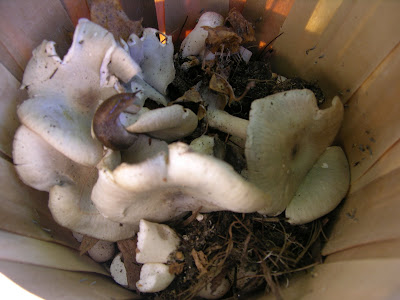
Just Mushrooms


Not presumed to dictate, but broiled fowl and mushrooms - capital thing!
Charles Dickens, English Novelist, 1812-1870


Angel's Wings

Variable Russula

Gem-studded Puffball

A Delectable Mix


Most people eat to live. Italians live to eat. I know this first hand as I am the product of two generations of venerable foragers. My earliest memories are of my grandfather, donning his old leather shoes, thread bare plaid shirt jacket, khakis and, most importantly, his 'lucky' basket as he set out for the Great Mushroom Hunt. My grandfather even went as far as noting: 'October 12th is THE best day to find the best mushrooms.' And find them he did. There were all sorts of ways to stave off thieves from his 'areas'... Stones were carefully placed along leaf-strewn woodland paths to
indicate coveted locations where the little gems seemed to thrive . 'Good spots' were returned to days later, especially after soaking rains, when the mushrooms exploded as if from outer space. And, there were the Italian names for the delectable fungii: signorinas and manellas which were among the most prized treasures. Who cares enough to take pictures of a car trunk full of mushrooms, as proud as if it were a grandchild?! It initially was all about the hunt, as I can relate to as an antique nut, but ultimately it was all about the food. This tradition was passed down to my dad, who passed it down to each of his five children. I, as an avowed naturalist, need no excuse to go into the woods. Foraging for mushrooms with my 80 something year old dad is a treat beyond words. And the reward... well, that is priceless.

A mushroom 'expert' is known as a mycologist. Before attempting to forage, be smart and educate yourself. Classes are available at Community Colleges and local Environmental organizations. I highly recommend the National Audubon Society Field Guide to North American Mushrooms, published by Gary H. Lincoff. It is well organized with beautiful photos and descriptions. Remember this: All mushrooms are edible - once!

Tried and True Mushroom Saute - Made the Italian Way

Thoroughly wash soil and leaves from fungii; cut into bite sized slices/pieces, bring to a boil for a minute or two in slightly salted water with a splash of lemon. Drain, rinse, freeze or proceed to cook by sauteing in olive oil: a sliced onion, minced garlic (2-3 cloves), chopped tomato, and parsley. Add drained mushrooms, seasoned with salt, hot pepper flakes and a splash of white wine or vermouth with olive oil to finish. Mushrooms will be ready to eat in 5 to 10 minutes. Enjoy!

signature

Monday, October 3, 2011

I is for Imperial Glass

Katy Blue Lace Edge pattern, 1930

Scroll Fluted pattern, late 1920's-early 1930's

Nu-Cut Pattern, 1920's

Genie Lace Edge pattern, 1950's

Imperial Glass Company was founded in 1904 by J.N. Vance of New Crystal Glass (1901). With the help of Edward Muhleman in Bellaire, OH it produced beautiful handmade glassware and continued manufacturing pressed glass with the advent of machinery during the early 20th C. Rapid growth and demand for glass continued and in 1909 Imperial introduced its first line of Carnival Glass, popularized by Fenton and others. It became known as one of the most elegant glassware companies in the US. The most recognized pattern from Imperial Glass is Candlewick (1939) whose design was inspired by a Colonial needlework technique and is often confused with the similar Anchor Hocking Burple pattern. More than 200 items were produced in the Candlewick line, competing with Fostoria Glass America and Cambridge Glass Rosepoint as the most collectible patterns of all time. It also launched the Cape Cod pattern as giveaway items in conjunction with the Quaker Oats Company and supplied F.W. Woolworth with much of its utilitarian glassware. During the 1920's, Imperial introduced its elegant and art glass lines known respectively as Nu-Cut and Nu-Art, imitating higher-end crystal and Tiffany glass. Yet despite the quality and popularity of its glassware the recession of the 1950's, coupled with the availability of inexpensive glassware from abroad strained the company to the breaking point. Although it filed for bankruptcy in 1931 and was able to recover, the global market changes of the mid 20th C proved too much. Lenox Glass of NJ bought out Imperial Glass in 1973, keeping it going until 1984 when production of all patterns from Imperial ceased. Although I recently came across a 6" Candlewick clear blown glass Candy Box with lid listed for $400.00 (!), generally pieces of Imperial Glassware are affordably available as elegant accents for your home. Happy Hunting!

signature

Monday, September 26, 2011

Ode to an Apple Tree

An apple tree puts to shame all the men and women that have attempted to dress since the world began. H.M. Beeher (1813 - 1887) Happy Picking!!!

Eatable Paintable Centerpiece

signature

Monday, September 19, 2011

Interior Design Coach Yvonne Blacker


Following is an interview with Design Coach and Editor of New England Finery Magazine, Yvonne Blacker.

Yvonne is a Fine Arts and Advertising Communications graduate of Boston College. She has worked in the fields of Graphic Design and Marketing in the Boston area prior to being a mother to four (!) boys. This was the job which led Yvonne to discover her true passion of home decorating/design. Her ability to apply design strategies and principles to interior spaces served her clients well as she decorated and brought life to homes in need - a Visual Communicator Extraordinaire!

1. Tell us about some first creative moments that led you to this career in Interior Design.

" I have always loved to draw and create. All through high school I pursued artistic instruction and got my first real job at the age of 16 working in a gift shop. Although I was hired to ring the register, I began illustrating and lettering promotions for the store, and was soon relied upon to design ads for the local paper. I pursued art studies in college, did a lot of pen and ink illustrations and began to learn how to do it all on the computer, which I absolutely love! Upon having children, decorating our home became something I enjoyed and found I was pretty good at. This soon led to clients seeking advice, which parlayed me into the world of interior design. In March 2009, I began a blog, Design Vignettes as a way to chronicle and explore interesting design-related topics, which in turn led to the creation of an on-line magazine, New England Finery."

2. Connect the dots to your current position.

"As Editor at New England Finery, I am able to combine my love for interior and graphic design with marketing, which brings all of my education and work experiences full circle. The bi-monthly issues allow for a definite beginning and end to the project which is quite satisfying, as well as an opportunity to explore design topics in greater detail."

3. What is the best - and worst - aspect of your job as Interior Decorator.

"I enjoy helping clients tell their stories by utilizing their prized possessions while creating a beautiful home. It is also very satisfying to help them discover their design sensibility while teaching them how to pull it all together with color and fabrics. The worst part of this job for me is spending money as my philosophy of working with what you have and the resources at hand resonates through and through."

4. What would your colleagues be surprised to learn about you?

"Probably that my house is far from 'done'.... My husband and I bought a fixer-upper and we have been fixing-it-up for eight years now! It is an old farmhouse with an attached barn that I have dreams to turn into a family room/function hall... someday. It would be a good thing if we get around to renovating it within the next five years - in time for our oldest son's graduation from high school!"

5. Are there any obstacles to your ambitions?

"Running out of time! Our family life is pretty simple and we try not to over schedule the kids or ourselves. However, managing a household of six people is time consuming to say the least. I probably food shop every three days and do two to three loads of laundry daily! When I am working on meeting a deadline for New England Finery, I have to shut my office door in order to get it done. I am willing to let a lot of housekeeping slide when it's crunch time."

6. Name a pet peeve.

"I like rooms that don't feel like they come out of a particular catalogue, store, or showroom. I prefer layered looks with a variety of furnishings from different sources. Personal objects that are unique to the homeowners are far more interesting to me than pieces that I have seen repeated over again. A home should reflect the people who live there, not someone else's design story."

7. What is your most treasured possession?

"I'd have to say my camera! I take it everywhere I go and use it to record family memories, to chronicle my work and to capture views of the world that inspires me. A close second would be my computer. With it I can bring my ideas to life, whether they are in the form of a magazine layout or a design board for a decorating client. I am on it every day and have serious withdrawal symptoms when apart from it for too long! There is one decorative item - a pretty chandelier - hanging in my office that was chosen especially for me; it makes me smile every time I see it."

Yvonne Blacker can be contacted at Yvonne Blacker Interiors.


signature

Monday, September 12, 2011

H is for Hazel Atlas


Hazel Ware Capri, Dots pattern, 1960's

Ovide pattern (1923 - 1935)

Starlight pattern (1938 - 1940)

Ribbon pattern (1932)

Hairpin pattern (1936-1940)

Colonial Block pattern (1920's - 1930's)

Beehive pattern (1950's)


Newport pattern (1936 - 1940)

Moderntone pattern (1934 - early 1950's)

Hazel Ware Capri, Colonial Swirl pattern, 1960's


In 1902, Hazel Atlas Glass Company was founded in Washington, PA, a result of a merger between four companies: Hazel Glass & Metals Co. (1887), the Atlas Glass Co. (1896), Wheeling Metal Plant, and the Republic Glass Co. The Hazel Atlas Glass Company expanded into fifteen locations (including plants in WV, OH, AL, and CA among others) to become the largest manufacturer of glassware in the world! Although utilitarian products from paste bottles to cold cream and mayonnaise jars represented the bulk of the company's assets, it was the expansion into dinnerware that catapulted the company to stardom. In the early 1920's through the Depression, Hazel Atlas produced beautiful affordable table ware in a myriad of colors and styles, beginning with the Ovide pattern (1923). Initially manufactured in green only it ultimately sustained Hazel Atlas for the next thirty years as the number one producer of Depression Glass. Its dinnerware line was expanded into the following patterns: Aurora/Lydia Roy (1937-38), Cloverleaf (1930-36), Colonial Block (1920's-30's), Florantine 1&2 ((1932-1953), Fruits (1931-53), Moderntone/Wedding Band (1934-early 50's), Platonite (1930-40), New Century (1930-35), Newport/Hairpin (1936-40), Ovide (1923-35), Ribbon/Roxana (1932), Royal Lace (1934-42), Ships, and Starlight (1938-40).

A myriad of colors were introduced such as Sunset Pink, yellow, Ritz Blue, amethyst and opaque white glass (similar to the milk glass popularized during the Victorian era). Hazel Atlas colors were distinguishable from other glass companies with trademarks and patents on several designs. Despite the variety of colors available, the most popular continued to be clear, green and Platonite (a process whereby color was essentially sprayed over opaque white glass). The 'HA' mark was first used in 1923 on the undersides of glassware, represented with the letter 'A' nestled under the letter 'H'.

Hazel Atlas' success made them one of the few publicly traded companies to pay a stock dividend during the Great Depression of the 1930's. The company remained in business until it was bought out by the Continental Can Company in 1956, with a line of Hazelware produced until 1963. You may find this awesome vintage Made in the USA glassware just about anywhere - beginning in your mom's or grandma's basements.... Have fun using and decorating with this happy Depression Glass from Hazel Atlas, guaranteed to make you smile!

Related Posts with Thumbnails