Friday, November 19, 2010

Gettysburg Address - 19 November, 1863


One hundred forty seven years ago today, then President Abraham Lincoln (1809-1865) addressed a nation * ravaged by Civil War. At least 620,000 Americans died in that Battle, exceeding any of the nations other wars from the Revolution (25,700), WWI (406,000), WWII (321,000) Korea (36,000) and Vietnam (58,200). As 19th President of the United States, Lincoln successfully lead the country through its first internal crisis, ended slavery and preserved the Union. He is consistently ranked by scholars as one of the greatest Presidents of the United States of America. May Lincoln's legacy live on in our hearts and actions.
* This rendition of the Gettysburg Address was created in September 2010 by Adam Gault and Stephanie Augustine, to celebrate Government of the people, by the people, and for the people.

Monday, November 15, 2010

Rock On

Rock...What does the word mean to you? When I turned one of those 'f' word birthdays, I decided to host a Women Rock party, whereby participants bring a rock graced with a word or words of significance to them. Each rock was added to a basket and we all randomly picked from it. The rock chosen graces our homes for a year, with the word on it binding each of us, as we think about what it meant to the person who brought it and what it has come to mean to the person who chose it. Over the years, these rocks have provided countless inspirations and comforts as we go along with our daily routines. They are reminders of our friendships, our aspirations and our lives; the rock as a symbol of strength, support, and solidity. Here are some of the words that graced our rocks: La Bella Figura, Balance, Chapters, Read swim drink - repeat as necessary, Acceptance, Faith, Gratitude, Healing, Hope, Journal, Perfection is an Illusion, Kindness, Climb more mountains watch more sunsets, Emerge, Explore, Grace, Perspective, Bling.....What would your rock say?

(If you would like to participate in WeekWord please leave a comment by Thursday in order for participants to link to your blog and see what you have come up with. I will post links to participants blogs on Friday. Thanks and I hope you have fun with this!)

My Rocks, 2010

'Stones are objects for contemplation; the more you look, the more you become aware of the journey each stone has made.' from Stones that Speak, Forgotten Features of the Landscape

Keep Calm and Rock On!
Please check out the following bloggers who have participated in this WeekWord:
(Anonymous) - Domestic Scribbles
Sally - Diario
Carola - CarolaBARTz
Christine E-E - Silver Linings 4 Me
Elizabeth - TEXTILSPANIELN
(Anonymous) - JUSTAHUMBLEBEE
Sally - Sow and Sew

Thank you all for making this so interesting! It is amazing how one little word conjures up so many meanings. No rockin' chairs for any of us yet! (So sorry, I couldn't resist.....)
* Carmen from Tails of a Biomouse will host WordWeek next. Check out her inspirational writing and don't forget to comment.

Rocks laid today, 19 November, 2010, 3:30 PM, South Main Street, Topsfield, Massachusetts

Thursday, November 11, 2010

November to Remember


Today I am participating in WeekWord which is being hosted this week at
Carola's blog - carola bARTz .

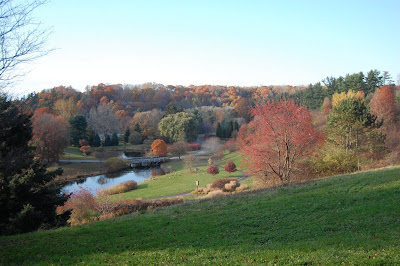
What does November mean to you? For me, it is the ultimate season of change. As a gardener, it is cleaning up the detritus of summer, cutting back perennials and appreciating the passing of time. Cold winds expose the bones of everything, making it easier to truly take stock of the beauty surrounding me. To delight in the wonders, to appreciate what we have, to ponder how lucky we are and to REMEMBER A VETERAN, on this 11th day of November, 2010

Joseph Emerson House, 1814, Topsfield, MA (photo taken 11 November, 2010)

Topsfield, MA (photo taken 11 November, 2010)

Commons, Topsfield, MA (photo taken 11 November, 2010)

World War I , known as the Great War, officially ended on 28 June, 1919 upon the signing of the Treaty of Versailles. However, fighting between the Allied Nations and Germany ceased on the 11th hour of the 11th day of the 11th month, 1918, with an armistice going into effect at that time signaling the end of 'the War to end all Wars'. As a result, U.S. President Woodrow Wilson proclaimed the first commemoration or Armistice Day on November 11 1919, with these words: "To us in America, the reflections of Armistice Day will be filled with solemn pride in the heroism of those who died in the country's service and with gratitude for the victory, both because of the thing from which it has freed us and because of the opportunity it has given America to show her sympathy with peace and justice in councils of the nations."

Frozen Fog on Mt. Lafayette, Pinkham Notch, NH - (photo taken 6 November, 2010 by Aaron & Becky)
A phenomenon whereby humidity approaches 100% and ice crystals that are suspended in the air settle-like magic. Aren't we lucky to freely experience life. Thank you Veterans!!!

Monday, November 8, 2010

Quilter Maggie Judd


A delectable delight displayed on a seasonal quilt by Maggie (Pine Cone Appetizer, blue and cream cheese with almonds)

1. How did you come to be such an accomplished quilter?

" I have three sisters and one took a class so I decided to try it with her. I have always sewed and love to craft and in 1991 my husband signed me up for a class he thought I might enjoy. And so it began...I am in a group called Seven Sisters whereby every year someone picks a fabric, a color, and a theme for a Challenge Quilt and each person works on a square reflecting their own creativity. Some themes were: "Joie de Vivre", "To Thy Known Self Be True". You develop a good sense of color and design the more you are exposed to others and the more you quilt. I participate in a Round Robin whereby a person works on a block for a month, sends it off to another to add a border, then to another and so on, round and round. One 'round' could be triangles, another 'round could be appliques. The first person to begin the 'round' ends up owning the quilt. It is this communal effort that makes it so special."

2. What is it about the process of quilting that inspires you?

"It is very relaxing...you meet a lot of nice people, build friendships and a sense of comradeship. I especially enjoy the fact that you are accomplishing something specific on one quilt, and you have other quilts going at the same time, all at different stages. So it never gets boring."

3. Do you have a role model?

"My mom loved to knit and sew; she sewed our clothes when we were young. My grandmother and my sisters were quilters."

4. What is your idea of mastery?

"I don't feel I am there yet. I am accomplished yet I always look to those who do things better. I guess you could say it is the process of challenging yourself to excellence that eventually leads to mastery. I have completed 100 or so quilts, ten made specifically as Wedding gifts."

5. Tell us the best and the worst part of designing and completing a quilt.

"The least favorite part is basting - putting the three layers together, with the backing, batting, then top. It is important to make sure everything is smooth before pinning it all together and basting it. I only use cotton fabric (and thread) because it wears well. Polyester thread will cut through the fibers at the seems and eventually fall apart. It takes a couple of days to assemble a quilt and a day to layer it. The quilting time depends on complexity of the pattern. I do both hand quilting as well as machine quilting. It could cost as much as $100 to send a queen size quilt out to be uniquely quilted with the use of a special darning foot that accommodates all that fabric. And, fabric for that quilt could cost $100 or more. So, you see, a price on a hand crafted piece is akin to purchasing an original work of art; most quilters do this as a hobby.

The best part of designing a quilt is choosing color combinations that compliment a specific quilt pattern. I enjoy the process and the challenge so much that when I am done I feel ready to give the quilt up and begin something new and exciting. There are many patterns to choose from, including: Harmonic Conversions, Nine Patch, Four Patch, Flying Geese, Lemoyne Star, Sawtooth Star, Half Square Triangles, Jacobs Ladder, Triple Irish Chain, and Pennsylvania Block to name a few!"

6. What would your colleagues be surprised to learn about you?

"I am an Engineer with a Masters in Computer Engineering. Math plays a big part in the quilting process, with lots of accurate measuring and precisely dissecting pieces into patterns. Corners must match up!"

7. Tell us about your typical day.

" To really accomplish something, four to five hours of time is important, although I 'll take two to three if that is all I can get. I spend the time quilting when my boys are in school; you need a good block of time just to set up."

8. Name a pet peeve.

"The corners need to match! That is the Engineer part of me speaking. I will take something apart and redo it if it is not right. The quality of the assembly and stitching is important to me."


Maggie is a member of the Merrimack Valley Quilters , Plastow, NH. All of her quilts are signed on the back with the name of the quilt, her name, the town she lives in and date completed. She sells at Trunk Shows and can be reached at mamju@juno.com .
Thank you Maggie for this delightful insight into your world of quilting. I, for one, am inspired!
Monday, November 1, 2010

Q is for Quilts

Wilendur, U.S.A. Linens
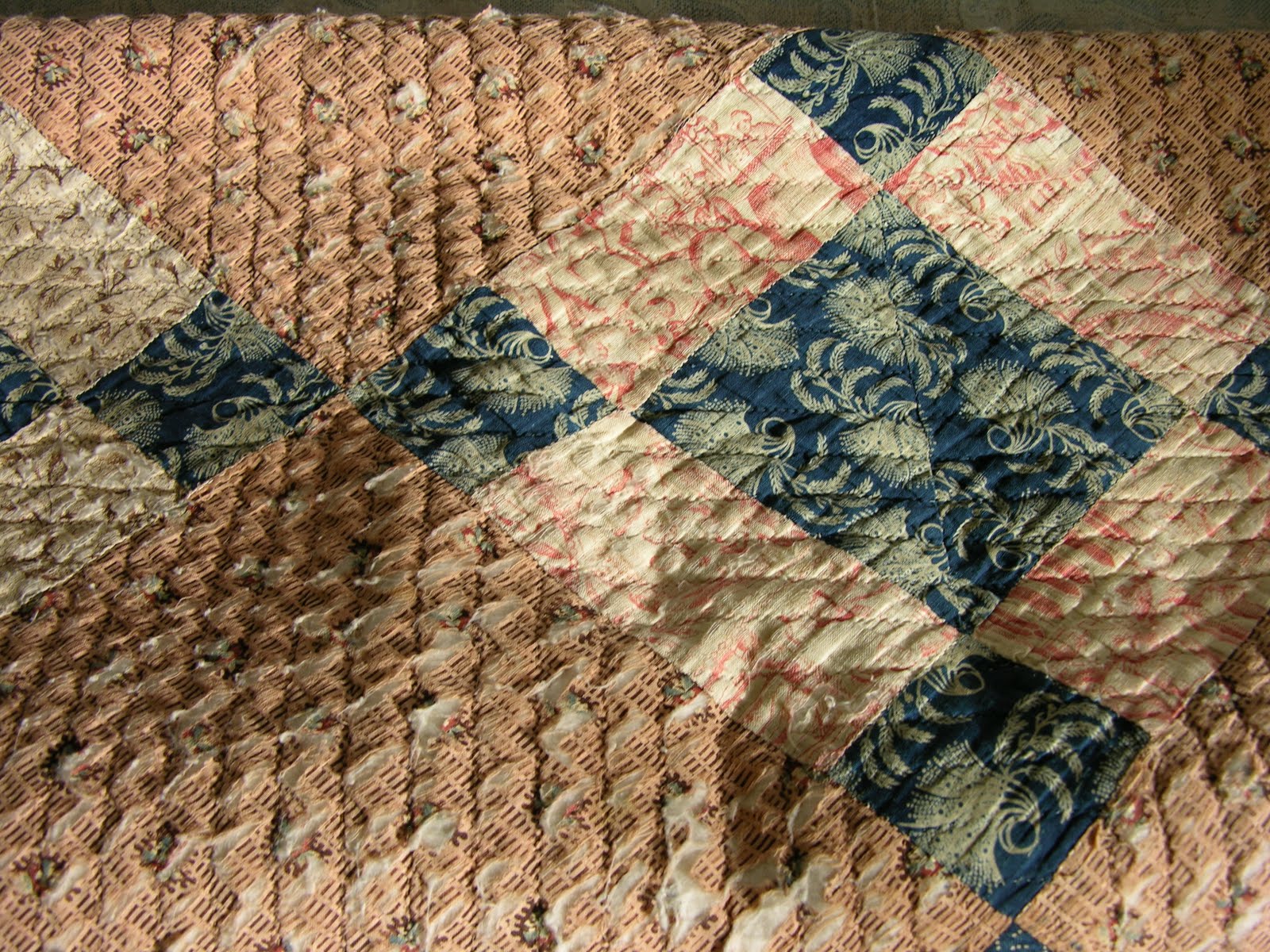
Whole Cloth Quilt (1750-1850)

Pieced Patchwork (1780-Present)

Crazy Quilt, Victorian era (1880-1910)

Tied-together Patchwork Quilt

Dresden Plate Quilt (Begun in 1974, by me, when I was 17. Still a work in progress)

The history of quilts began in ancient Egypt and China, with blankets made by stitching together three layers of fabric, with batting in the middle for warmth. Quilts were used in the 11th C as padding for protection beneath armor, and it was the very wealthy European women who had the luxury and time to do needlework strictly for pleasure. It is believed that the first American quilts were most likely Whole Cloth Quilts made by layering a solid top to a bottom with batting in between and elaborate stitching holding the piece together. Quilts were made as necessities for life and the notion of gathering together for fun in quilting bees was essentially a myth. Since fabric used was basically cast-off clothing, many earlier quilts were Appliqued with patchwork and a center design surrounded by borders of multiple pieces of cloth. Quilts provided comfort from the elements of the weather, warmth from drafty domiciles, and privacy partitions for rooms within. The women of this early period relished the emotional comfort of a favorite quilt on a bed, as a symbol of an orderly, peaceful life. It was the growth of the textile industry in 1840 that made fabric so readily available and accessible. As the century progressed, women had more luxury of time to be creative and take on a project as an expression of their talents. In 1876, the Philadelphia Centennial Exposition with its Japanese pavilion exposed the Victorians to Asian inspired art forms and ultimately influenced the direction of arts and crafts, as well as interior and exterior designs. As a result, Crazy Quilts, with their asymmetrical designs and pieced embroidered scraps of velvet, brocade and silk, were in vogue and created expressly for display. Although the designs appear haphazard, they were carefully planned and painstakingly pieced together. As leisure time was now a part of a woman's life, many styles and forms of quilts evolved, from simple tied together to elaborate patchwork. Quilts were and are pieces of artwork to be used and cherished.


Monday, October 25, 2010

Ode to Autumn


Hydrangea quercifolia, Oakleaf Hydrangea

Acer saccharum, Sugar Maple

Carya glabra, Pignut Hickory


Besides the autumn poets sing, A few prosaic days, A little this side of the snow, And that side of the haze. - Emily Dickinson, American poet, 1830 - 1886


Monday, October 18, 2010

P is for Pottery


Pottery includes earthenware, stoneware and porcelain that represents one of the oldest technologies on earth. As an art form it contributes unique pieces attracting much admiration and appreciation by collectors.

The process of forming a piece of pottery involves the formation of clay by hand and often with the aid of a potters' wheel. Glazing and firing finish the piece to create the lasting final product of beauty. These lovely pieces are just some that will soon be available in my Shoppe. Check it out!
Related Posts with Thumbnails